Trees, like animals, can also experience albinism, though it is extremely rare.
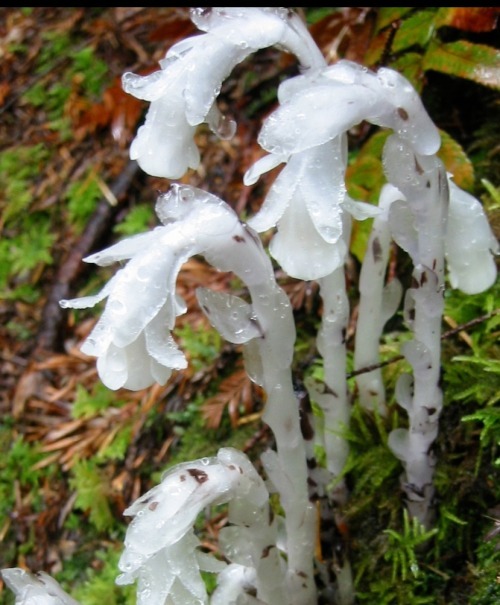
the reason it’s rare is because without chlorophyll, the plant can’t get energy, and dies shortly after sprouting unless it has some other source of food. so if you see a plant as big as the one in the picture that doesn’t have any green in its leaves, it’s getting its nutrition from the roots of a neighboring plant of the same species, feeding on the sugars created by the other plant’s photosynthesis.
albino plants are basically vampires.
thats metal af
That or the neighbouring plants are helping to keep it alive.
There has been research saying plants can share resources with one another, such as carbon and nitrogen, when one is deficient, so this plant likely has an abundance of mycorrhizal fungi on its root system that isn’t so much parasitizing from its neighbours as it is borrowing.
It’s not a vampire. It’s a disabled plant being supported by a community of healthy individuals who have more than enough nutrients to share.
The real vampire plant is actually Indian Pipe, which lacks chlorophyll and sucks out nutrients from photosynthetic trees, meaning they can grow in dark places without much trouble. They look badass as well.
this is the coolest thing, because every plant is connected to every other plant by underground fungi! scientists now hypothesize that fungi actually evolved long before plants, so plant root systems evolved with fungi that were already in the soil. fungi aren’t just useful for the survival of plants, they are essential for the survival of most vascular plants! (vascular plants = those with root structures)
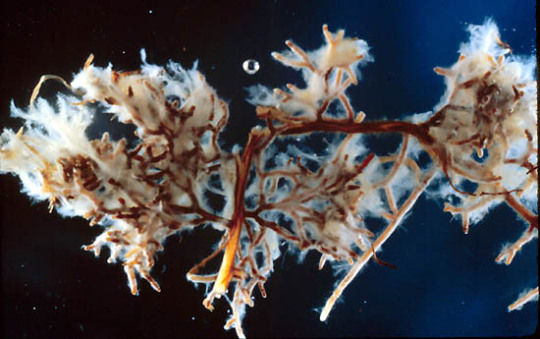
networks of fungi under the ground can cover miles and miles, and each fungus sends out very long branches, called hyphae. these hyphae can surround the root tips of a plant (these are called ectomycorrhizae, because ecto = outside, myco = fungus, rrhizae = root), which looks something like this:
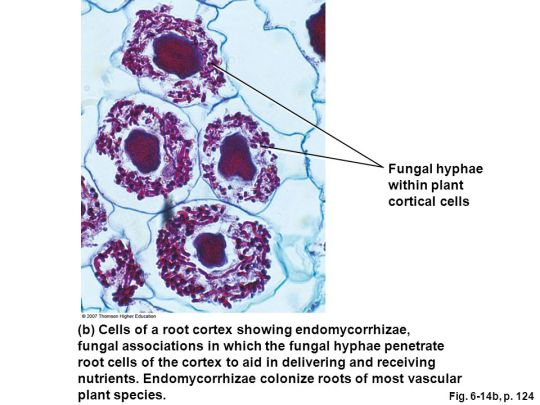
(picture source) alternatively, plant roots can be colonized by endomycorrhizae (endo = inside), which are WILD, because they essentially just bust through the plant cell walls and, like, chill directly inside of the root cells? like HI here we are we’re moving in now! that looks like this, on a cellular level:
(picture source) despite the occasional door-busting, this is a good, codependent relationship for both parties, because plants provide the fungi with sugars and energy, while fungal networks can grow even farther than plant root networks, so they transport essential nutrients to the plants as well as helping the roots to gather enough water. fungi are also the world’s greatest decomposers, and break down rotting organic material in the soil to increase the amount of carbon surrounding the root networks!
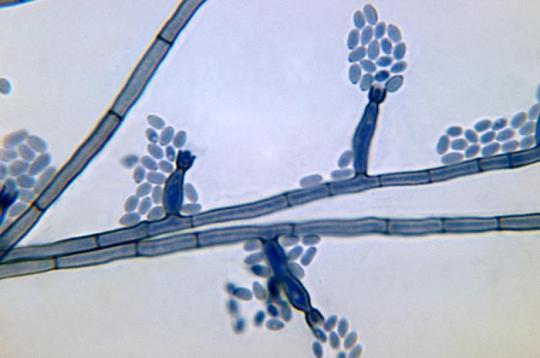
fungi are uniquely disposed to transport materials and to communicate over long distances because they have a supercool cellular structure! so fungal hyphae are only sort of composed of individual cells, but they’re cells with serious boundary issues. most species of fungi have septate hyphae (septum means boundary or partition), where individual cells have dividers between them, but these dividers have, like, GIGANTIC ass holes in them. the concept is kinda like this:
(picture source) these pores are so ENORMOUS that they can fit entire organelles through them! so one cell can just pass its entire nucleus or mitochondria through a pore to its neighbor, which is WILD! you can literally see these septa when you look at fungi under a microscope, like look at this beautiful bullshit!
(picture source) something like 90% of vascular land plants are colonized by mycorrhizae, so when you are standing outside, know that literally every plant around you, every blade of grass beneath you, is connected to every other plant by a vast network of fungal friends, roommates, and helpers! sometimes a SINGLE fungus will be connecting all of these plants to one another! ALL THE PLANTS ARE HOLDING HANDS.
there are these incredibly intimate, cooperative relationships going on beneath your feet that allow plants to help each other and communicate with one another (or compete with one another), and there is NO WAY that we would have enormous trees like we do without fungi to help them expand their reach and weather different soil conditions! the plants are talking to one another, y’all, and we’re the only ones who can’t hear them.


 NanoRain